

Privacy Policy

Privacy Policy for FESECU

Last updated: 06.11.2025

FESECU (“we”, “our”, “us”) respects your privacy and is committed to protecting your personal information. This Privacy Policy explains how we collect, use, store, and safeguard your data when you use our mobile application (“App”) and related services.

By downloading or using FESECU, you agree to this Privacy Policy.


1. Information We Collect

We may collect the following types of information:

a. Personal Information

  • Name, date of birth, gender
  • Contact details (email, phone number, address)
  • PAN, Aadhaar, or other KYC documents as required by SEBI and regulatory authorities
  • Bank account details for funds transfer and settlement
  • Nominee and FATCA details (if applicable)

b. Technical and Device Information

  • Device type, operating system, and version
  • IP address and geolocation (for compliance and security)
  • App usage logs, crash data, and performance metrics

c. Transactional Information

  • Trade orders, portfolio holdings, and transaction history
  • Linked Demat and trading account information

2. How We Use Your Information

Your data is used to:

  • Create, verify, and maintain your trading and Demat account
  • Process transactions and settlements
  • Enable trading and investment features on the platform
  • Comply with legal and regulatory obligations
  • Enhance user experience, app security, and service quality
  • Communicate important account information, alerts, and statements

3. Data Security and Encryption

We take your data security seriously.

  • All sensitive personal and financial data is encrypted both in transit and at rest using industry-standard encryption protocols (such as AES-256 and HTTPS/TLS).
  • Multi-layer firewalls and access control systems restrict unauthorized access.
  • Regular audits and vulnerability assessments are conducted to maintain data integrity and security.

Despite our best efforts, no electronic transmission or storage method is 100% secure. However, we follow the highest security standards as per SEBI and RBI guidelines to protect your data.


4. Account Deletion and Data Retention

You have the right to request account deletion at any time. Upon receiving your verified request, your account and associated data will be permanently deleted, except for information that must be retained to comply with legal, regulatory, or audit requirements (such as SEBI-mandated record retention).

To request account deletion, please contact our support team at stoptrade@fesecurities.in from your registered email ID.

We retain data only for as long as it is necessary to provide services or comply with applicable laws.


5. Data Sharing and Disclosure

We never sell or rent your personal data. Your information may be shared only with:

  • Exchanges, depositories, or regulatory bodies (as per SEBI and exchange norms)
  • Authorized third-party service providers (for operations, analytics, or compliance)
  • Banking and payment partners for transaction processing
  • Law enforcement agencies, when required by applicable law

All partners are bound by strict confidentiality and data protection agreements.


6. Your Rights

You can:

  • Access, review, and update your personal information
  • Withdraw consent for optional data processing
  • Request correction or deletion of your data (subject to legal limitations)
  • Contact our Grievance Officer for privacy-related issues

7. Cookies and Tracking

We may use cookies and analytics tools to improve functionality and performance. You can manage permissions via your device or browser settings.


8. Third-Party Links

FESECU may contain links to external sites (such as NSE, BSE, or CDSL portals). We are not responsible for their privacy practices. Please review their respective privacy policies.


9. Updates to This Policy

We may update this Privacy Policy periodically. The revised version will be published in the App and on our website with a new “Last Updated” date.


10. Contact Us

If you have any questions or privacy-related concerns, please contact:

FE Securities Pvt. Ltd.
814 Arunachal Building, 19 Barakhamba Road,
New Delhi – 110001
Phone: +91 98107 87578, 011 23350670
Email: fes@fesecurities.in
Compliance Officer: Anil Kumar
Process to Verify KYC Details (Email and Mobile Number) Registered with KRA

KYC is a one-time exercise while dealing in securities markets. Once KYC is done through a SEBI registered intermediary (broker, DP, Mutual Fund, etc.), you do not need to undergo the same process again when approaching another intermediary.

In case of any change in KYC details, please submit a change request form along with the supporting documents.

SEBI Regulations on KYC Validation

As per the latest SEBI circular SEBI/HO/MIRSD/FATF/P/CIR/2023/0144 dated August 11, 2023, KYC Registration Agencies (KRA) are responsible for validating clients' KYC details as per their records.

Impact of Non-Compliance

  • Clients shall not be allowed to trade on any exchange or manage their open positions until they comply with KYC requirements.
  • Clients’ trading and demat accounts will remain deactivated until the KRA details are updated and validated.

How to Update and Validate KRA Details

As per SEBI guidelines, it is mandatory to verify your KYC details such as email ID and mobile number registered with the KRA (KYC Registration Agency).

Updation Process

This is required when your KYC details are incorrect in the KRA portal. You need to furnish the following documents via email at fes@fesecurities.in. We will update your KRA details.

  • Duly filled and signed KRA form with photo
  • Self-attested copy of PAN card
  • Self-attested copy of Aadhaar card

Once we receive the above documents, we shall update our records.

Validation Process

After processing your request, we will inform KRA to update their records. Once updated, you will receive an SMS to your registered mobile number and an email to your registered email ID for validation. Check your spam, trash, or deleted folder if you do not find the email.

Alternative Validation Process

Follow these steps to check with which KRA your KYC is registered:

  1. Visit cvlkra.com
  2. Click on the "KYC Inquiry" section
  3. Enter your PAN and captcha details
  4. Click ‘Submit’ to fetch your status
  5. Refer to the ‘KRA’ column to find out the name of your KRA

The KRA can be one of the following:

  • CVL KRA
  • KARVY KRA
  • NDML KRA
  • DOTEX KRA
  • CAMS KRA

Once you identify your KRA, visit their respective website and follow the instructions to verify your email ID and mobile number.

Types of KYC Status

  • On Hold
  • Registered
  • Validated

If Your Email/Mobile Number is Incorrect

Update your email ID and mobile number. Once updated, follow the below procedure:

When KRA updates your details, you will receive an email and SMS for validation. Your task is complete once you validate your email ID and mobile number.

After validation, the process takes 5-7 working days to update your records and activate your trading account (if deactivated).

Links to Validate Your Mobile and Email with KRA Agencies

Responsibilities of Investors

  • Deal with a SEBI registered DP for opening demat account, KYC and Depository activities.
  • Provide complete documents for account opening and KYC (Know Your Client). Fill all the required details in Account Opening Form / KYC form in own handwriting and cancel out the blanks.
  • Read all documents and conditions being agreed before signing the account opening form.
  • Accept the Delivery Instruction Slip (DIS) book from DP only (preprinted with a serial number along with client ID) and keep it in safe custody and do not sign or issue blank or partially filled DIS.
  • Always mention the details like ISIN, number of securities accurately.
  • Inform any change in information linked to demat account and obtain confirmation of updation in the system.
  • Regularly verify balances and demat statement and reconcile with trades / transactions.
  • Appoint nominee(s) to facilitate heirs in obtaining the securities in their demat account.
  • Do not fall prey to fraudsters sending emails and SMSs luring to trade in stocks / securities promising huge profits.

Dos and Don’ts for Investor

  • Receive a copy of KYC, copy of account opening documents.
  • No minimum balance is required to be maintained in a demat account.
  • No charges are payable for opening of demat accounts.
  • If executed, receive a copy of Power of Attorney. However, Power of Attorney is not a mandatory requirement as per SEBI / Stock Exchanges. You have the right to revoke any authorization given at any time.
  • You can open more than one demat account in the same name with single DP/ multiple DPs.
  • Receive statement of accounts periodically. In case of any discrepancies in statements, take up the same with the DP immediately. If the DP does not respond, take up the matter with the Depositories.
  • Pledge and /or any other interest or encumbrance can be created on demat holdings.
  • Right to give standing instructions with regard to the crediting of securities in demat account.
  • Investor can exercise its right to freeze/defreeze his/her demat account or specific securities / specific quantity of securities in the account, maintained with the DP.
  • In case of any grievances, Investor has right to approach Participant or Depository or SEBI for getting the same resolved within prescribed timelines.
  • Every eligible investor shareholder has a right to cast its vote on various resolutions proposed by the companies for which Depositories have developed an internet based ‘e-Voting’ platform.
  • Receive information about charges and fees. Any charges/tariff agreed upon shall not increase unless a notice in writing of not less than thirty days is given to the Investor.

Dos and Don’ts for Investor

Sr.No. Guidance
1 Always deal with a SEBI registered Depository Participant for opening a demat account.
2 Read all the documents carefully before signing them.
3 Before granting Power of attorney to operate your demat account to an intermediary like Stock Broker, Portfolio Management Services (PMS) etc., carefully examine the scope and implications of powers being granted.
4
Always make payments to registered intermediary using banking channels.
No payment should be made in name of employee of intermediary.
5
Accept the Delivery Instruction Slip (DIS) book from your DP only (pre- printed with a serial number along with your Client ID) and keep it in safe custody and do not sign or issue blank or partially filled DIS slips.

Always mention the details like ISIN, number of securities accurately. In case of any queries, please contact your DP or broker and it should be signed by all demat account holders.

Strike out any blank space on the slip and Cancellations or corrections on the DIS should be initialed or signed by all the account holder(s).

Do not leave your instruction slip book with anyone else.

Do not sign blank DIS as it is equivalent to a bearer cheque.
6
Inform any change in your Personal Information (for example address or Bank Account details, email ID, Mobile number) linked to your demat account in the prescribed format and obtain confirmation of updation in
system
7 Mention your Mobile Number and email ID in account opening form to receive SMS alerts and regular updates directly from depository.
8 Always ensure that the mobile number and email ID linked to your demat account are the same as provided at the time of account opening/updation.
9
Do not share password of your online trading and demat account with
anyone.
10
Do not share One Time Password (OTP) received from banks, brokers, etc.
These are meant to be used by you only.
11 Do not share login credentials of e-facilities provided by the depositories such as e-DIS/demat gateway, SPEED-e/easiest etc. with anyone else.
12 Demat is mandatory for any transfer of securities of Listed public limited companies with few exceptions.
13
If you have any grievance in respect of your demat account, please write to
designated email IDs of depositories or you may lodge the same with SEBI online at https://scores.gov.in/scores/Welcome.html
14
Keep a record of documents signed, DIS issued and account statements
received.
15 As Investors you are required to verify the transaction statement carefully for all debits and credits in your account. In case of any unauthorized debit or credit, inform the DP or your respective Depository.
16 Appoint a nominee to facilitate your heirs in obtaining the securities in your demat account, on completion of the necessary procedures.
17 Register for Depository's internet based facility or download mobile app of the depository to monitor your holdings.
18
Ensure that, both, your holding and transaction statements are received
periodically as instructed to your DP. You are entitled to receive a transaction statement every month if you have any transactions.
19 Do not follow herd mentality for investments. Seek expert and professional advice for your investments
20 Beware of assured/fixed returns.

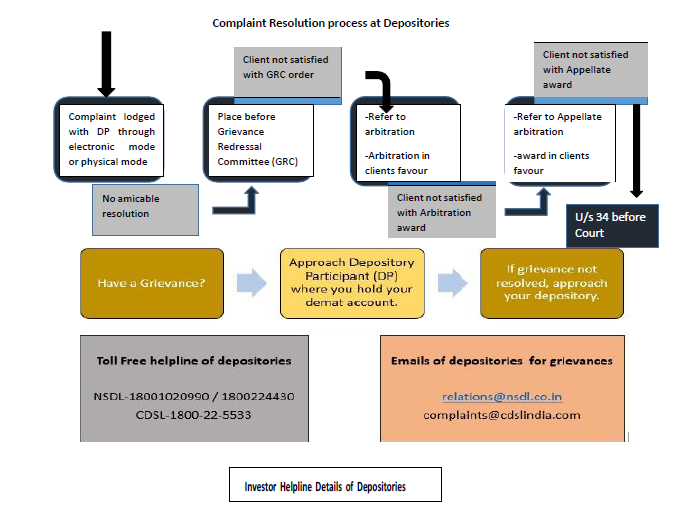
Complaint Resolution process at Depositories

Miscellaneous services

Transaction alerts through SMS, e-locker facilities, chatbots for instantaneously responding to investor queries etc. have also been developed..

E-account opening

Account opening through digital mode, popularly known as “On-line Account opening”, wherein investor intending to open the demat account can visit DP website, fill in the required information, submit the required documents, conduct video IPV and demat account gets opened without visiting DPs office.

Transposition cum dematerialization

In case of transposition-cum-dematerialisation, client can get securities dematerialised in the same account if the names appearing on the certificates match with the names in which the account has been opened but are in a different order. The same may be done by submitting the security certificates along with the Transposition Form and Demat Request Form.

Online instructions for execution

Internet-enabled services like Speed-e (NSDL) & Easiest (CDSL) empower a demat account holder in managing his/her securities ‘anytime-anywhere’ in an efficient and convenient manner and submit instructions online without the need to use paper. These facilities allows Beneficial Owner (BO) to submit transfer instructions and pledge instructions including margin pledge from their demat account. The instruction facilities are also available on mobile applications through android, windows and IOS platforms.

e-DIS / Demat Gateway

Investors can give instructions for transfer of securities through e-DIS apart from physical DIS. Here, for on-market transfer of securities, investors need to provide settlement number along with the ISIN and quantity of securities being authorized for transfer. Client shall be required to authorize each e-DIS valid for a single settlement number / settlement date, by way of OTP and PIN/password, both generated at Depositories end. Necessary risk containment measures are being adopted by Depositories in this regard.

e-CAS facility

Consolidated Account Statements are available online and could also be accessed through mobile app to facilitate the investors to view their holdings in demat form.

Linkages with Clearing System

For actual delivery of securities to the clearing system from the selling brokers and delivery of securities from the clearing system to the buying broker.

Basic Services Demat Account (BSDA)

The facility of BSDA with limited services for eligible individuals was introduced with the objective of achieving wider financial inclusion and to encourage holding of demat accounts. No Annual Maintenance Charges (AMC) shall be levied, if the value of securities holding is upto Rs. 50,000. For value of holdings between Rs 50,001- 2,00,000, AMC not exceeding Rs 100 is chargeable. In case of debt securities, there are no AMC charges for holding value upto Rs 1,00,000 and a maximum of Rs 100 as AMC is chargeable for value of holdings between Rs 1,00,001 and Rs 2,00,000.